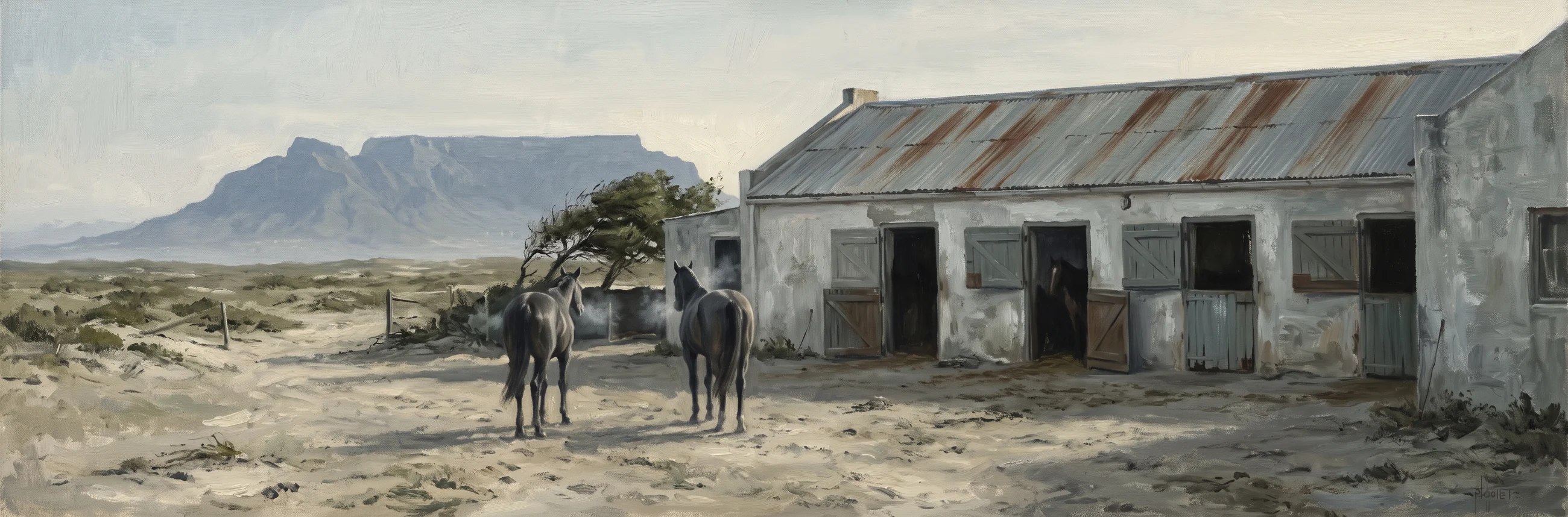
Three generations back, a horseman out of Rosario.
Rosario · the Cape · the Rand · Brisbane — a family that kept Spanish names for eighty years in a country that had no use for them.
A modern painted impression, not a photograph, and not a picture of any building this family is known to have owned — it stands for the yard at Rugby recorded in the 1931 building file. The signature in its corner is the image generator's invention.
This archive was built for David Defranceski, born in Johannesburg, living in Brisbane — and it runs backwards from his mother: to Germiston, where her father died; to Wynberg, where her grandparents married in 1911 and their sons were baptised; to Newlands, where the horseman died in 1950; and to Rosario de Santa Fe, where his own passport says he was born and where the registers do not yet agree.
It is a public archive with one rule: the living are left out — omitted, not hidden. And a second rule, which is harder: every claim says how well it is known. Documented Inferred Family lore
One tree, and the joint that is missing
One tree, oldest first. Everyone on it is documented — the Uruguayans as much as the South Africans. What is not documented is a single joint in the middle of it, and rather than hide that, the tree is broken open at exactly the place where the evidence stops.
The pale pills say which country holds the record, not where anyone felt they belonged — and they use today’s borders, which is an anachronism worth admitting: Canelones in 1791 was the Banda Oriental of the Spanish empire, and Uruguay did not exist for another thirty-seven years. The break carries no country pill, because there is no record to place.
Married at Canelones, 8 January 1791. He natural de Córdova la Llana, son of Félix Llerena and Rosalía Aguilar; she natural de las Asturias, daughter of Rodrigo and Rosa Fernández. A dragoon. In 1798 he swore an oath and could not sign his name.
Pedro Antonio (1793), Agustina Ramona (1795), Fidel (c.1799), Justa Pastora (1800), Dominga Josefa (1804), José Loreto (1806), Luis Escolástico (1811), Avelino (1815). The padón of 1812 returns six in the house.
Lerena Lenguas and Lerena Traibel — a large, well-recorded Montevideo family. Luis Lerena Lenguas is the name the 1866 Rosario act reaches for: it says the only Lerena in that parish was natural del Estado Oriental.
Inferred That Pablo Armando came out of this family is this archive’s reading, not a record. It rests on a rare surname, the River Plate, and the 1866 act — and on nothing that names him.
No Juan Carlos Lerena appears in any indexed record in Argentina or Uruguay. Not a baptism, not a marriage, not a burial. Everything above this line is documented and everything below it is documented. Nothing yet joins them.
Named by their son on his Argentine enrolment card, filled in at the consulate in Cape Town. That is the whole of what is known of them — two names, in his own hand, and no record of either anywhere else.
In South Africa Robert Paul Lerena. Racehorse trainer, then owner. His passport gives the town and the day; his estate is 1847/50. Everything above this row is reached through him, and everything below it descends from him.
Her name is a count that does not come out. Septima means seventh, and this archive said for a year that she was the seventh daughter. She is the sixth of nine — the GRO index, searched on her mother’s maiden surname across 1870–1893, returns nine children of William Taylor and Mary Ann Hellen Brayley and no tenth. Her own birth is registered at Bideford, December quarter 1884, 5b/506. What was corrected →
And her line goes back further than his. Where the Lerena side stops dead at two names, hers is documented through three English censuses to a mason born at Westleigh about 1777, and a Scotswoman from Haddington who died in the Northam alms house. The Taylors →
A railwayman; the “Louis” of the 1950 will. He was born six years before his parents married, and baptised three months before the wedding — the baptism of 12 June 1911 names Pablo Armando as his father, and that is what proves Pablo Armando and Robert Paul are one man.
He is named for the grandfather on the enrolment card. A son born at the Cape in 1920 carrying Juan Carlos corroborates that card from the other side of the ocean, eleven thousand miles from any Argentine record.
A salesman, married at Johannesburg. Named with this exact birth date in his father’s 1950 estate and again on his own death notice 6746/71. David’s grandfather, and from here to the present there is no inferred link in the descent.
What would close it: a Rosario baptism for Pablo Armando naming his father; any record at all of Juan Carlos Lerena; or a Montevideo act that puts a Juan Carlos in the trunk. What is unproved → · What cannot be closed →
Where this family can actually be put
The River Plate, the Cape, and the English west country. Every dot is a place this archive can put a named person in, and its size is how many stand there. The biggest are labelled; the colours are this archive's own regions. The coast and the borders under them are real — Natural Earth, clipped to this frame — so a dot can be read as somewhere rather than as a position in an empty box.
They were not a Rosario family.
Both volumes of the Rosario baptism index have now been read end to end — 1731 to 1901. Across a hundred and seventy years the surname appears once, and the act behind that one entry says of both parents “naturales del E. Oriental”: natives of Uruguay.
No baptism for Pablo Armando, none for his father, no Lerena marriage in the parish register for 1867–1885, and not one Lerena in the 1895 national census of Santa Fe. Then the register itself was read act by act, and the read now stands at seven hundred and ninety-two consecutive baptisms, to test whether the 1945 typescript index could be trusted at all. It agrees with the index everywhere.
A household that lives in a parish leaves baptisms. This one leaves nothing — which is no longer a gap in the searching but a fact about the family, and it points the search across the river. What was read → · Hypothesis 1c →
The same day, the Rosario death index was opened for the first time. Its two surviving L sections hold no Lerena either — and for 1840–1881 it has no L section at all: the book runs A to F and stops. The gaps →
Across the river, the family is not obscure at all.
The panel above ends by pointing the search into Uruguay. It went. Nuestra Señora del Carmen la Mayor, the Cordón, Montevideo, 13 December 1831 — the baptism of a grandson of Sancho Llerena: “Fueron Padrinos Don Fructuoso Rivera, Presidente de la República, y su esposa Doña Bernardina Fragoso”.
The first constitutional President of Uruguay stood godfather, with the first lady beside him. Godparents of that rank are not chosen at random — and everything found since runs the same way: Justiniana’s father a General; Cándido Juanicó an abogado; Luis Eugenio dead a hacendado in 1901; a daughter married to the philosopher José Pedro Massera.
The Montevideo house is now documented from Sancho’s generation to the 1890s: two marriages for Don Luis — the first, to Carolina Oliva in 1836, nobody here knew about — seven children for Luis Eugenio, eight for his brother Gilberto Lerena, co-founder of the Argentine Stud Book, whose family crossed to Buenos Aires between October 1886 and October 1890. The Uruguayan house → · Gilberto →
And Juan Carlos Lerena is in none of it. Fifteen people of that surname are now placed in two Montevideo generations, and Pablo Armando’s father is not among them. That is the question, and it is still open.
His father has a name.
An Argentine army enrolment card — clase de 1882, born at Rosario de Santa Fé, enrolling office Capetown — names Juan Carlos Lerena and María Lerena as the parents of Pablo Armando Lerena. It had been sitting behind a machine-made index that spelled him Armand Lorena and placed him 1,400 km away in Salta.
Corroborated from the other side of the ocean: his eldest son, named in the 1950 estate, was Ricardo Juan Carlos Lerena. Read the card →
What the family remembered, and how it has held up
Four traditions were handed down. Three now have documents; one has evidence against it.
| The claim | Where it stands |
|---|---|
| An Argentine great-grandfather, from Rosario | Confirmed His own passport gives Rosario de Santa Fe, 22 February 1882, and records him as Argentine by birth. The tradition was exactly right. The passport → |
| He brought horses | Confirmed Trainer on his passport; horse-dealer at his marriage; the Argentine 6th Cavalry in 1915; Race Horse Owner at his death; a 1931 file for stables at Rugby; a yard that took apprentices; and, among his debts, a claim for £26 of carrots. The horses → |
| He was Consul General | Disputed Nothing supports it. On the 1940 passport the consular signature belongs to A. B. Bayne; Pablo Armando is the bearer. The family did hold an Argentine consular passport, which may be how the story began — and the family's own note says the post may have been Uruguayan. |
| He had an ostrich farm | Doubtful The deeds registers show him holding no land at all, and every document places him in Cape Town racing rather than the Karoo. Not disproved — Oudtshoorn is unsearched, and a farm could have been leased. South Africa → |
Where it stands, and where it stops
The line is closed and documented from Pablo Armando Lerena — born 1882, died at Newlands in 1950 — through Nuno Fernando Lerena to David's mother. His wife Mary Septima Taylor can be traced four generations further, to a James Taylor born about 1796 in Suffolk, and a family settled at Bideford and Northam in north Devon.
Above him the line now runs one generation further, to Juan Carlos Lerena and María Lerena, on his own army enrolment card. That card also does what no other document had managed: it corroborates the passport from outside the family, in Argentine hands, giving the same year and the same birthplace. The card →
What still stops is the baptism — and on 13 September 2026 the question changed shape. The Rosario index has been read letter by letter, under any surname, for 1881, 1882 and 1883; the 1879–1901 volume end to end; and now the earlier volume too, 1731 to 1879, eighty openings. Across both volumes and a hundred and seventy years, the surname Lerena appears once. Until 1888 the cathedral was the city’s only parish. A boy born there in February 1882 to a father named Lerena ought to be in that book; so ought his brothers and sisters, and his father’s marriage, and none of them is. A household that lives in a parish leaves baptisms. This one leaves nothing. The sweep →
And the one Lerena who is there points away from Argentina altogether. Folio 229, February 1866: the act names Don Luis Lerena Lenguas and Doña Julia Juanicó and says of both, “naturales del E. Oriental” — natives of Uruguay. The godfather, another Don Luis Lerena, stood by proxy, which is what one does from the other side of the river. Published Uruguayan genealogy makes that family the Lerena Lenguas of Montevideo — one of whose sons co-founded the Argentine Stud Book, and Pablo Armando trained and owned racehorses. Nothing yet links the two houses. But it says where to look next. Hypothesis 1c →
And one thing the card does not settle, said plainly: María is written with her husband’s surname. Whether she was a Lerena by birth — which would make the marriage one between kin — or was entered under her married name, the card cannot tell. Her maiden name is the next thing to find.
The families who married in
Most people carrying this name have no proved relationship to the line. This is what has been decided about each. The marriages, in full →
Connected to the line16
- LERENA30
- TAYLOR10
- FERNANDEZ5
- BRAILEY4
- PELAEZ2
- AGUILAR1
- BRAYLEY1
- CHAPPELL1
- CORDERO1
- FORBES1
- GONZALEZ1
- JUANA1
and 4 more, all named below
Unplaced — high interest3
- LERENA17
- LLANOS1
- LLERENA1
Unplaced — of interest10
- LERENA22
- LLERENA6
- PELAEZ4
- FERNANDEZ2
- CHAVARRIA1
- CORDERO1
- LENGUAS1
- LEON1
- LORENA1
- MONTANO1
Unplaced180
- LERENA218
- LLERENA27
- LARENA14
- SERENA10
- GONZALEZ8
- JUANICO7
- MARTINEZ7
- CARDOZO6
- LENGUAS6
- LORENA6
- MORATORIO6
- PELAEZ6
and 168 more, all named below
Excluded — the name is coincidental5
- LERINA4
- BUYS1
- GONZALEZ1
- LARENA1
- LERENA1
What this archive has established
They were not a Rosario family
Both volumes of the Rosario baptism index have been read end to end — 1731 to 1901. In a hundred and seventy years the surname appears once, and that act calls both parents «naturales del E. Oriental»: natives of Uruguay. What the registers say →
His father has a name
The 1908 ficha de enrolamiento, Cajón 985, names Pablo Armando's father and mother — Juan Carlos Lerena and María — and then stops. It is the one document holding the Argentine end of this line up. The card →
A birthplace, a birthday, a trade
Passport Série A No. 07962, issued at Cape Town on Christmas Eve 1940, settles three things in his own lifetime's paperwork, and gives his profession in one word: Trainer. What it settles →
The English side goes further than the Spanish
The Taylors reach James, born about 1796 — four generations — while the Lerenas stop one generation above Pablo. The wall is not in the family; it is in what Argentina lets the public read. The Taylors →
The archive in numbers
Every one of these is a link to the page that earns it.
What is still missing
Published deliberately: an archive that lists only its answers is advertising; one that lists its questions can be helped by strangers. The enrolment card names Juan Carlos and María Lerena and nothing else is known of either — not a date, not a marriage, not a death. Argentine civil registration is not open, so the wall is administrative rather than evidential. Open questions →
Nothing here is taken on trust because it appears in a family tree. Where a record has been seen, it is cited; where it has not, the claim is marked. See Method.